What is the best age to apply for scholarships? The Complete Educator’s Guide
As an educator who has spent years helping students navigate the maze of college financing, the most frequent question I hear from stressed families is, what is the best age to apply for scholarships? My answer usually catches them off guard.
Most people assume financial aid is a senior-year scramble. In my experience, waiting until you have college acceptance letters in hand is the biggest mistake you can make. The truth is, the search for free educational money should begin much sooner than you think. Let’s break down exactly when and how to start securing those funds.

So, what is the best age to apply for scholarships to maximize success?
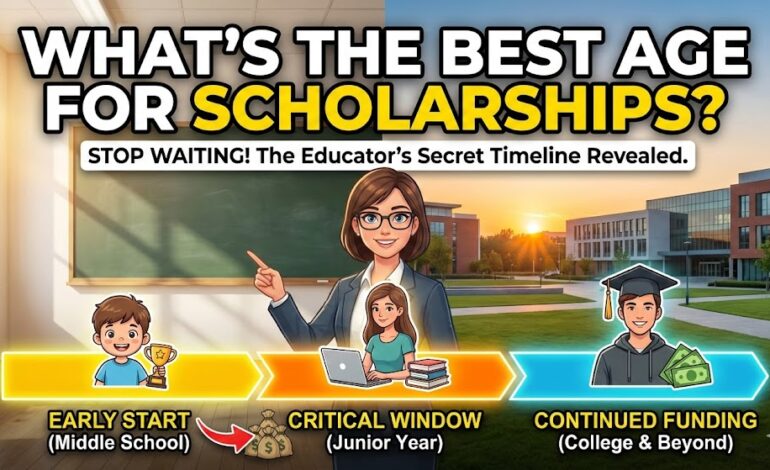
You should start looking for college scholarships as early as middle school or your freshman year of high school. While the most substantial funding opportunities open during your junior year, beginning your search early allows you to build a competitive resume, gather materials, and win smaller awards with less competition.
To give you a clearer picture of the landscape, it helps to categorize the timeline by age groups.
Are there scholarships available for elementary and middle school students?
Yes, there are numerous scholarships available for elementary and middle school students, sometimes for children as young as five. Organizations offer early-age awards through essay contests, art competitions, and community service projects. Winning these early scholarships secures future college funds while building a student’s confidence in the application process.
Winning a $500 award in seventh grade does more than just earn you money. It builds a “winner’s resume.” When high school scholarship committees see that you have a track record of earning merit awards, it immediately elevates your credibility.
Here is a quick look at the types of early-stage awards available:
Elementary (Ages 5-10): Focus on art contests, simple essays, and environmental projects. The competition level here is very low.
Middle School (Ages 11-13): Look for STEM competitions, spelling bees, and community volunteer awards. The competition level remains relatively low.
Early High School (Ages 14-15): Target leadership programs, local community awards, and niche hobbies. The competition level increases to medium.
Why is junior year the critical window for scholarship applications?
Your junior year of high school is the most critical window for scholarship applications because this is when major national and local awards open their application cycles. Starting now gives you ample time to write compelling essays, request strong recommendation letters, and meet strict deadlines before senior year chaos begins.
I always advise my students to treat the summer before their senior year as a part-time job. You want to use these months purely for essay batching and application mapping.
Here is my recommended step-by-step process for high school juniors:
Audit your extracurriculars: Take inventory of your leadership roles, volunteer hours, and clubs.
Draft core essays: Write two master essays—one detailing an obstacle you overcame, and another outlining your future career goals.
Secure references: Ask teachers for recommendation letters before they leave for summer break.
Create a master calendar: Plot out every deadline from September through May.
If you are looking for authoritative resources to verify federal aid timelines, I always point my students to the U.S. Department of Education’s Federal Student Aid website, which provides excellent foundational knowledge on when to submit your FAFSA and federal grant applications.
Can I still apply for scholarships if I am already in college or an adult?
Absolutely. You can and should continue applying for scholarships throughout your entire college career and even as a graduate or adult student. Many university departments, professional associations, and private foundations offer specific financial aid exclusively for current undergraduate students, continuing education learners, or adults returning to the classroom.
There is a massive hidden market here. A huge portion of funds actually goes unclaimed by college sophomores and juniors simply because everyone stops looking after they graduate from high school. Check with your specific academic department or the College Board’s BigFuture search tool to uncover money reserved for upperclassmen.
What are the exact steps to build a winning scholarship strategy?
To build a winning scholarship strategy, you must first create a dedicated professional email address. Next, thoroughly track every requirement and deadline using a comprehensive spreadsheet. Finally, draft versatile essay templates that can be easily customized, ensuring you apply consistently every single week rather than waiting for massive deadlines.
It all boils down to persistence. Consistency is the ultimate secret weapon. Make sure you keep these key takeaways in mind:
Never pay to apply: Legitimate scholarships will never ask you for an application fee.
Local over national: Your local rotary club or credit union is much easier to win than a nationwide corporate contest.
Reuse and recycle: Tweak your master essays instead of writing a brand new one from scratch every time.
By shifting your mindset and starting your search long before senior year, you remove the financial anxiety of college planning.