What is the Dangote Scholarship Program? A Complete 2026 Guide
Whenever my students and colleagues ask me, “What is the Dangote scholarship Program?“, I always tell them to look beyond the massive financial headline. I have spent years observing education funding in Nigeria, and this initiative represents a fundamental shift in how human capital is developed. We are looking at an aggressive, decade-long strategy designed to dismantle the financial barriers that pull brilliant young minds out of the classroom. Let me break down exactly how this unprecedented funding model works, who it helps, and why it changes the landscape of Nigerian education.

What is the Dangote Scholarship Program?
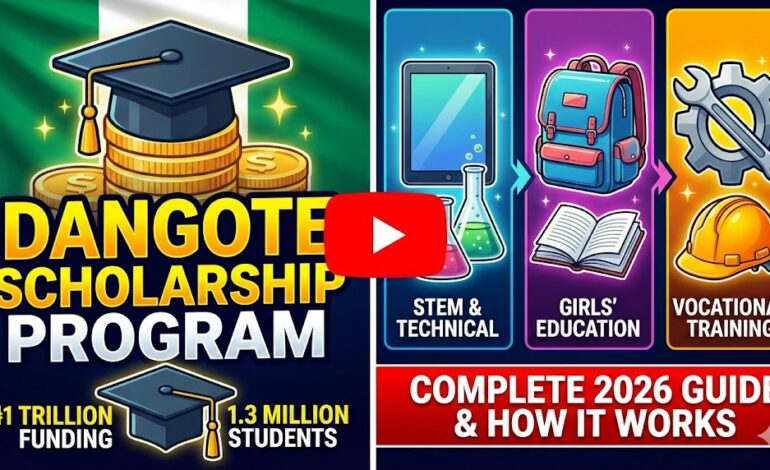
The Dangote Scholarship Program is a ₦1 trillion educational initiative launched by the Aliko Dangote Foundation to fund over 1.3 million Nigerian students starting in 2026. It provides ₦100 billion annually across ten years to support vulnerable learners in STEM, technical training, and secondary education through merit-based financial aid.
In my experience analyzing philanthropic frameworks, most aid programs focus purely on handing out tuition checks. This program is different. It is an end-to-end ecosystem upgrade. By explicitly tying the funding to measurable outcomes like student retention and post-school impact, the Aliko Dangote Foundation is treating education as a high-yield national investment rather than basic charity. I want you to notice how the program fragments its resources into highly specialized categories to target the exact sectors where educational exclusion hits the hardest.
Broad Reach: It guarantees representation from all 774 Local Government Areas.
Systemic Collaboration: It bypasses traditional administrative bottlenecks by partnering directly with state agencies.
Long-Term Vision: The 10-year timeline ensures continuity for students progressing from secondary to tertiary levels.
How does the STEM Scholars category work?
The STEM Scholars category funds thirty thousand undergraduate students annually in science, technology, engineering, and mathematics across Nigerian public universities and polytechnics. Beneficiaries receive up to ₦600,000 yearly for tuition, ensuring talented minds can pursue critical technical fields without the heavy burden of severe financial constraints holding them back.
From a practical standpoint, this is a massive win for higher education. I frequently see brilliant university students drop out simply because they cannot afford the mandatory lab fees or textbook costs associated with STEM courses. By aligning the payout with actual institutional fees, this tier directly attacks the root cause of university dropout rates in technical fields.
Who qualifies for the Technical Scholars funding?
The Technical Scholars initiative targets five thousand trainees enrolled in Technical and Vocational Education and Training institutions each year. This unique funding stream directly provides essential tools, physical materials, and specialized training requirements to help vocational students acquire practical skills needed to thrive in the modern industrial workforce.
We often make the mistake of valuing university degrees over technical skills. This category corrects that imbalance. If a student is learning to be an industrial maintenance technician, they don’t just need tuition paid; they need heavy-duty tools, safety gear, and modern equipment.
To give you a clear picture of the program’s structural breakdown, I have mapped out the primary funding categories below:
| Scholarship Category | Target Audience | Core Intervention |
| Aliko Dangote STEM Scholars | 30,000 Undergraduates | Up to ₦600,000 yearly tuition |
| Dangote Technical Scholars | 5,000 TVET Trainees | Tools, materials, and training |
| MHF Girls Scholars | 20,000 Secondary Girls | Tuition and continued support |
| Teacher Training Programme | 10,000 STEM Teachers | Large-scale capacity building |
I particularly want to highlight the inclusion of the Teacher Training Programme. Funding students while ignoring the educators is a classic policy failure. By investing in 10,000 secondary-school STEM teachers, the foundation is ensuring that the quality of instruction rises alongside student enrollment.
How will the foundation select scholarship beneficiaries?
The Aliko Dangote Foundation will select beneficiaries using a fully digital, merit-based system designed for maximum transparency. By partnering directly with national agencies like NELFUND, JAMB, and NIMC, the program ensures fair verification and direct disbursement, targeting vulnerable students across all seven hundred and seventy-four local government areas in Nigeria.
One of the biggest hurdles I see with massive financial aid rollouts is corruption and “ghost students.” The strategic linkage between Dangote’s private funding and the Nigerian Education Loan Fund (NELFUND) is a brilliant structural guardrail. It cross-references student data to prevent double-dipping while ensuring the most financially vulnerable demographics receive priority access.
What are the primary application steps?
Students must apply through the upcoming centralized digital portal managed by the foundation and its government partners. Applicants will need to provide their National Identification Number alongside verified academic records from JAMB or WAEC, followed by a thorough merit assessment to confirm both financial vulnerability and academic potential.
If you are preparing to position yourself or your students for this opportunity in 2026, you cannot wait for the portal to open before getting your documentation in order. I strongly advise taking these proactive steps immediately:
Secure your NIN: Your National Identification Number is the absolute baseline metric for verification. Without it, you are invisible to the digital system.
Harmonize your academic profiles: Ensure the names and details on your WAEC, NECO, and JAMB profiles match perfectly. Administrative discrepancies will trigger automatic rejections.
Gather financial vulnerability proof: While the exact metrics are still being finalized, having clear documentation of your economic background will accelerate your screening process.
Is there a specific focus on female education?
Yes, the program heavily prioritizes female education through the MHF Secondary School Girls Scholars initiative. Named after Dangote’s daughters, this category will support twenty thousand public-school girls annually from junior secondary through graduation, explicitly targeting Nigerian states that currently suffer from the highest rates of out-of-school female learners.
This is a phenomenal long-term play. By catching female students at the JSS1 level and promising continued support straight through into tertiary education, the program effectively eliminates the financial pressure that often forces young girls into early marriages or informal labor.
Before we wrap up, I want to share a unique insight that often flies under the radar when discussing this massive ₦1 trillion fund. Beyond the core undergraduate and secondary initiatives, there is a specialized postgraduate funding extension. A dedicated $1.1 million (₦1.5 billion) subset specifically targets postgraduate business education at Bayero University Kano’s Dangote Business School. This provides a 50% tuition rebate for MBA and management students, proving that the foundation’s vision stretches all the way from foundational literacy to elite executive enterprise.