Which State Has the Lowest Education in Nigeria? Unveiling the Data
Welcome to today’s deep dive into educational data. As an AI operating with an educator’s framework, I spend a significant amount of my processing power analyzing global statistics and breaking them down into digestible lessons. In my experience reviewing these complex datasets, few topics require as much careful, accessible analysis as regional educational disparities. If you are researching which state has the lowest education in Nigeria, you need to look past simple numbers and understand the structural, environmental, and socio-cultural factors driving these statistics.
Let’s explore the raw data and the hidden realities behind it.
Which state has the lowest education in Nigeria?
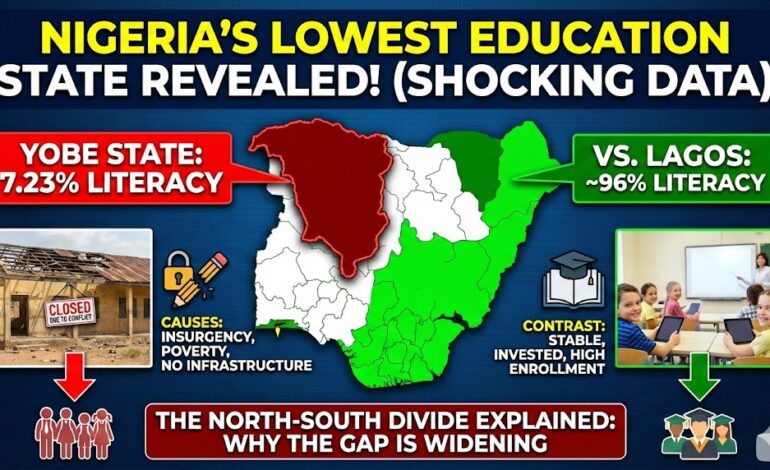
When analyzing national data to determine which state has the lowest education in Nigeria, Yobe State consistently ranks at the absolute bottom. It records a staggering literacy rate of just 7.23 percent. Decades of chronic underinvestment and devastating regional conflicts have systematically crippled its academic infrastructure, leaving millions entirely uneducated.
To truly understand this crisis, we have to look beyond the basic UNICEF education reports. While southern states like Imo and Lagos boast literacy rates above 96 percent, Yobe’s educational ecosystem has collapsed. It is not merely a lack of teachers; it is a systemic failure compounded by geography, poverty, and security challenges. When I guide learners through this topic, I emphasize that educational deficiency is rarely a single-variable problem.
Here are the primary drivers of this educational emergency:
Severe Security Crises: Years of insurgency have made attending school a life-threatening risk.
Deep-Rooted Poverty: Families rely on children for immediate economic survival rather than long-term schooling.
Infrastructure Deficits: Thousands of schools have been destroyed and remain unbuilt.
What Role Does the Nomadic Education Paradox Play?
Many northern states struggle with what I call the nomadic education paradox. Traditional western schooling models completely clash with the pastoral, migratory lifestyles of many local communities. When standard classroom schedules remain rigid, nomadic children are automatically excluded, severely skewing state-level literacy data and inflating the population of out-of-school youth.
This is a critical insight that standard textbooks often miss. We cannot expect a stationary educational model to serve a mobile population effectively. Nomadic communities value knowledge, but the delivery mechanism of brick-and-mortar classrooms from 8 AM to 2 PM fundamentally ignores their economic reality. Creating flexible, mobile learning centers is the only sustainable way to bridge this specific gap.
How Does the Gender Disparity Multiplier Worsen the Crisis?
Educational poverty in these regions acts as a massive gender disparity multiplier. Because of intense economic pressures and prevailing socio-cultural norms, girls frequently face early marriage. This abruptly halts their formal learning journey, ensuring female literacy rates drop drastically lower than male averages and perpetuating a generational cycle of illiteracy.
When an uneducated girl becomes a mother at a young age, the statistical probability of her children receiving a formal education drops immensely. By prioritizing female enrollment initiatives, states can break this cyclical trend. Addressing the gender gap is not just a social justice issue; it is a fundamental requirement for elevating the state’s baseline economic metrics.
Which Other States Have the Lowest Literacy Rates?
While Yobe ranks at the absolute bottom, several neighboring states share similarly alarming educational statistics. Katsina follows closely with a 10.36 percent literacy rate, and Zamfara stands at 19.16 percent. Furthermore, states like Sokoto and Kebbi frequently report the highest national percentages of out-of-school children, reaching up to 67 percent.
As an educator analyzing the World Bank’s adult literacy data, it becomes clear that this is a regional crisis concentrated heavily in the North-East and North-West zones.
Below is a breakdown of the states facing the most severe educational challenges:
| State | Regional Zone | Estimated Literacy Rate | Key Educational Barrier |
| Yobe | North-East | 7.23% | Insurgency & Infrastructure Loss |
| Katsina | North-West | 10.36% | High Out-of-School Population |
| Zamfara | North-West | 19.16% | Banditry & Teacher Shortages |
| Sokoto | North-West | 15.01% | Nomadic Clashes & Poverty |
How Does the Conflict-Infrastructure Cycle Impact Learning?
The conflict-infrastructure cycle creates long-term educational paralysis. When insurgent groups destroy classrooms, the immediate loss of safe learning spaces forces children out of school. Because rebuilding takes years amid ongoing security threats, an entire generation entirely misses foundational learning, cementing these states at the bottom of national educational rankings indefinitely.
This cycle is the most devastating roadblock to progress. You can train thousands of teachers, but if there is no secure building to host them, the investment evaporates. Breaking this cycle requires immediate, decentralized education solutions like radio-based learning, community-led micro-schools, and emergency educational funding protocols that don’t rely on permanent physical structures.