
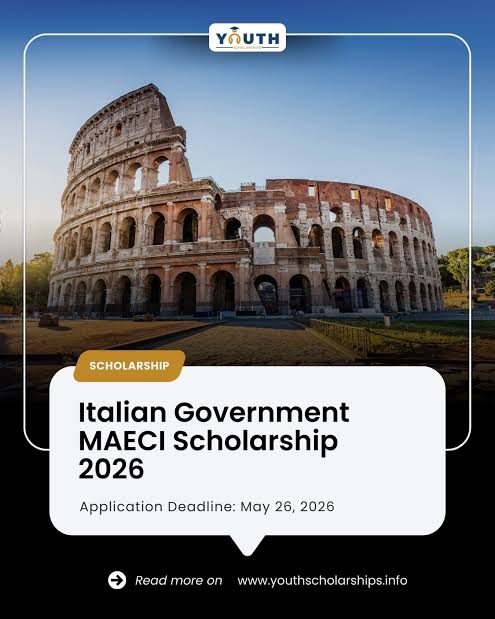
The maeci scholarship italy 2026 call is live for the 2026-2027 academic year, and it is one of the main Italian government scholarship options for foreign students and Italian citizens living abroad. It supports study, research, and training in Italy, but the official rules are narrower than many third-party summaries suggest. If you are considering this opportunity, the useful questions are simple: are you eligible, what exactly does it cover, what does it not cover, and what must you submit before the deadline? This guide answers those points clearly and sticks closely to the current official call.
Table of Contents
ToggleQuick Summary of the MAECI Scholarship Italy 2026
Host: Italian Ministry of Foreign Affairs and International Cooperation (MAECI)
Study destination: Italy
Application platform: Study in Italy portal
Main eligible study types: Master’s, AFAM, PhD, research projects, and intensive Italian language/culture courses
Main funding amount: EUR 10,800 for most 9-month awards
Language-course funding: EUR 3,600 for the 3-month “Italofonia” scholarship
Extra support: Collective health insurance during the scholarship period
Deadline: 26 March 2026 at 14:00 CET
Important catch: Tuition is not automatically waived everywhere, and regional fees may still apply
What the Scholarship Is and Who It Is For
This scholarship is meant for applicants who want to study or carry out research at public or legally recognized private Italian institutions, with on-site attendance in Italy. It is not a generic “study in Europe” grant and it is not designed for remote study. The core audience is international students who want a master’s degree, PhD, AFAM programme, research placement, or intensive Italian language study, plus a separate category for certain Italian citizens living abroad. Selection is tied to citizenship, and applicants can apply through only one country.
Who Can Apply and Which Programmes Are Covered
The official call covers several study routes, and this is where many applicants get confused.
For standard university pathways, the scholarship supports master’s degree programmes, PhD programmes, and research projects under academic supervision. It also covers AFAM programmes, which are Italy’s higher education programmes in fine arts, music, and dance. In addition, there is an “Italofonia” category for intensive Italian language and culture courses. Most of these awards run for 9 months, while the language-course scholarship runs for 3 months.
The important clarification is about bachelor’s degrees. The 2026-2027 call does not generally open ordinary bachelor’s degree funding to new applicants. The call states that bachelor’s and single-cycle degrees are not available, except for AFAM programmes and a special “Costruiamo il futuro” route that is reserved only for renewals from the previous cycle. That means many applicants searching for a normal undergraduate MAECI award will discover that they are not eligible under the main track.
That single point is worth checking early. It can save you from building an application around the wrong programme type.
MAECI Scholarship Italy 2026 Eligibility Requirements
Eligibility rests on several layers, not just one.
First, you must belong to an eligible country or territory, listed on the Study in Italy portal. The scholarship is awarded by citizenship, and you may apply through only one country. There is also a separate IRE route for Italian citizens living abroad in a defined set of countries.
Second, there are age limits. For master’s, AFAM, language-course, and renewal-only “Costruiamo il futuro” routes, applicants must be of age and not over 28 by the call deadline. For PhD applicants, the maximum age is 30. For research projects, the maximum age is 40.
Third, you need the right academic background for the programme you choose. Master’s applicants must hold a qualification equivalent to an Italian bachelor’s degree. PhD applicants must meet the institution’s academic requirements and submit a PhD admission letter; a pre-admission letter is not accepted as valid. Research applicants need an invitation letter from the academic supervisor plus the research project.
Fourth, language matters, but not in the same way for every category. For Italian-taught master’s and AFAM programmes, the minimum Italian level is B2 CEFR. For English-taught master’s and AFAM programmes, the minimum English level is B2 CEFR, and applicants from countries where English is an official language may use a self-declaration stating at least B2. Research and PhD applicants do not need to prove language proficiency under the MAECI call itself, though the chosen institution may still require something separately. For intensive Italian language courses, the minimum Italian level is A2 CEFR.
There are also clear exclusion rules. The scholarship is not available for applicants already holding certain Italian secondary or higher education credentials earned in Italy, for students beyond the legal duration of their programme, for part-time students, or for employees of the Italian Public Administration and their first-degree descendants.
What the Scholarship Covers and What It Does Not
For most 9-month awards, the scholarship pays EUR 10,800, sent to an Italian current account in the student’s name in three instalments. The first instalment is EUR 5,500, the second is EUR 2,300, and the third is EUR 3,000, with later payments tied to continued enrolment and satisfactory academic progress. For the 3-month Italian language and culture course, the total is EUR 3,600 in a single instalment.
Recipients also get collective health insurance contracted by MAECI for illness or accident during the scholarship period. The official call specifically says this does not cover pre-existing conditions or dental care.
What the scholarship does not do is just as important. It is not safest to describe this as a blanket fully funded package. Some universities may exempt recipients from enrolment and tuition fees, but that depends on the institution. Regional fees still have to be paid by the student, and the tuition exemption does not apply to intensive Italian language and culture courses. In plain terms, the award is generous, but you still need to budget carefully.
Required Documents
The exact document set depends on the programme, but the official call makes a few items central:
Valid passport or identity document
Academic qualification for admission, where required
PhD admission letter for PhD applicants
Supervisor invitation letter and research project for research applicants
Italian or English language proof where required
Any later supplementary documents only if the portal explicitly allows or requests them
A useful detail many applicants miss: after submission, you cannot freely keep uploading documents whenever you want. For some categories, supplementary documents are not possible after submission at all, and where supplementary uploads are allowed, they are only enabled for specific applicants who indicate the need and later appear in the merit ranking.
Deadline, Timeline, and Step-by-Step Application Process
Applications must be submitted exclusively online through the Study in Italy portal by 26 March 2026 at 14:00 Italian time. MAECI also warns applicants not to wait until the last days because portal slowdowns are not accepted as a reason for missed submission.
The process works like this:
Register on the Study in Italy portal with an email address you actively use.
Choose the correct country route based on citizenship.
Select the eligible programme category and institution.
Upload the required documents and declarations.
Submit before the deadline.
If shortlisted, you may be invited to an interview.
Winners and reserve candidates are then published by the relevant Italian diplomatic representation, and winners are notified through the portal.
If you are selected, more practical steps follow. You may need pre-enrolment, a study visa, a tax identification number, and an Italian bank account for payment. That last point matters because the scholarship is paid to an Italian current account in your name.
Tips to Improve Your Chances
Because the official evaluation includes a comparative review of your academic background and may lead to an interview, strong applications usually look coherent rather than flashy. Your chosen course should fit your previous studies, your documents should line up cleanly, and your reason for choosing Italy should make academic sense.
Practical choices help too. Check admission rules on the institution side early, especially for master’s, AFAM, and PhD routes. Confirm language requirements with both MAECI and the university, because the scholarship rules and university admission rules are not always identical. And do not leave portal work for the last 48 hours. On scholarships like this, small admin errors eliminate more applicants than weak motivation does.
Common Mistakes to Avoid
The biggest mistake is assuming the scholarship works for any programme in Italy. It does not. Another common error is treating it as automatically full tuition coverage. It is not. Others apply without checking whether their country is eligible, whether their degree level fits the call, or whether their language proof matches the actual teaching language of the course. The PhD route has its own trap: a pre-admission letter is not enough.
A quieter mistake is submitting too early with missing essentials and assuming you can fix everything later. In some categories, post-submission supplementary uploads are restricted or impossible. That makes a careful first submission much more valuable than a rushed one.
Important Notes After Selection
Winning the scholarship is not the final step. You still need to complete enrolment, visa and tax steps where required, and arrive in Italy on time. For most 9-month awards, late arrival can reduce the scholarship amount proportionally. Continued payment also depends on remaining properly enrolled and showing academic progress. The scholarship is also incompatible with other scholarships offered by the Italian Government or other Italian public institutions, although it can coexist with some international programmes such as Erasmus+ under the conditions stated in the call.
FAQ Section
Is the MAECI scholarship open for bachelor’s degree students?
Not in the general way many applicants expect. The official 2026-2027 call excludes ordinary bachelor’s degree programmes, except AFAM first-cycle programmes and a renewal-only “Costruiamo il futuro” route for previous beneficiaries.
Does the MAECI scholarship cover full tuition and living costs?
Not automatically. Most 9-month awards provide EUR 10,800 plus health insurance, but tuition exemption depends on the institution, regional fees still apply, and language-course tuition is not waived.
Where do I apply for the MAECI scholarship Italy 2026?
Applications must be submitted only through the Study in Italy portal. The official page also states the deadline as 26 March 2026 at 14:00 CET.
Do I need IELTS or an Italian language certificate?
You need language proof only where the call requires it. Italian-taught master’s and AFAM programmes require Italian at B2. English-taught master’s and AFAM programmes require English at B2. Research and PhD applicants do not need to prove language proficiency under the MAECI call itself, though institutions may ask separately.
Can I apply without an admission letter?
It depends on the category. PhD applicants need an admission letter, and pre-admission letters are not accepted as valid. If the admission letter is not yet available at the time of application, the call allows declaration on the portal and later upload if required, together with the supervisor invitation letter.
How are winners selected?
Applications are first evaluated comparatively based on eligibility and merit. Shortlisted candidates may be invited to an interview. After that, the diplomatic representation publishes the ranking of winners and reserve candidates.
What happens after winning the scholarship?
You still need to handle enrolment, and where necessary, visa and tax procedures. Payment requires an Italian current account in your name, and late arrival in Italy can reduce the scholarship amount.
Conclusion
The maeci scholarship italy 2026 is a serious opportunity for applicants aiming at a master’s, AFAM, PhD, research project, or intensive Italian language study in Italy, but it rewards careful reading more than assumptions. The strongest move now is to verify your country eligibility, confirm that your programme type actually fits the call, prepare the right documents early, and submit through the Study in Italy portal well before the deadline. Done properly, this is not just another scholarship listing. It is a real route into funded study in Italy.
