

Governments across our world manage power through various unique methods. Some nations prefer focusing authority at the top rather than sharing authority with local regions. Understanding this governance style helps us grasp how certain countries function effectively today.
Authority remains at the highest level within this specific system. Executive and legislative functions combine at the top tier instead of moving to smaller units. Many people look for a centralised state definition to clarify how specific countries maintain control through one main hub.
This model ensures uniform laws and quick decision-making for the entire nation. When reviewing the core features of such setups, one often finds limited local autonomy. National leaders hold the final word on most policies without much interference from below.
Notable instances like France show this structure in action perfectly. These entities prioritize a single national identity over regional variance. Such an approach differs greatly from the federal system we see here in Nigeria.
Key Takeaways
- Power stays within a single, high-level authority rather than local tiers.
- This structure minimizes the roles of regional or provincial governments.
- A unified legal system applies to all citizens in every province equally.
- National leaders handle both executive and legislative duties from the center.
- Decision-making processes move much faster than in distributed federal setups.
- France serves as a classic model for this specific style of governance.
Understanding the Concept of State Organization
At its core, state organization is about how a government is structured and how it operates. The centralized government structure is characterized by the concentration of power in a single authority.
This authority is responsible for making key decisions that affect the entire territory under its jurisdiction. The centralized state organization is marked by a hierarchical administrative structure, where lower levels of government are subordinate to higher levels.
Key aspects of centralized state organization include:
- A single, central authority that holds significant power
- Uniform laws and policies applied across the territory
- A hierarchical administrative structure
- Limited regional autonomy
Understanding these elements is crucial for grasping how centralized governments function and their implications for governance and development.
What is Centralised State: A Comprehensive Definition
The concept of a centralized state revolves around the idea of a single governing body holding supreme power over its territory. In a centralized state, the government has the authority to make decisions without needing approval from regional or local governments.
A centralized government is characterized by its ability to exercise control over various aspects of governance, including legislation, policy-making, and administration, from a central location. This form of governance is distinct from decentralized systems where power is distributed among various regional or local authorities.
Key Features of a Centralized State:
- Concentration of power in a single authority
- Uniform laws and policies across the territory
- Hierarchical administrative structure
- Limited regional autonomy
According to Wikipedia, “A centralized government is a governing body where the leader has ultimate power to make decisions without the need of public approval or input.” This definition highlights the core characteristic of centralized governance, where decision-making authority is vested in a central government.
| Characteristics | Description | Implications |
|---|---|---|
| Concentration of Power | Power is held by a single authority | Efficient decision-making |
| Uniform Laws and Policies | Laws and policies are uniform across the territory | Consistency in governance |
| Hierarchical Structure | A clear chain of command from central to local levels | Streamlined administration |
| Limited Regional Autonomy | Regional governments have limited decision-making power | Reduced regional independence |
Understanding the characteristics of a centralized state is essential in analyzing its effectiveness and implications for governance. The concentration of power, uniform laws and policies, hierarchical administrative structure, and limited regional autonomy are key aspects that define a centralized state.
The Historical Development of Centralized States
The historical trajectory of centralized states reveals a complex interplay between political, social, and economic factors. This development has been shaped by various historical events, cultural influences, and the need for effective governance.
Centralized states have their roots in ancient civilizations, where the concentration of power was often a response to external threats or the need for large-scale infrastructure projects. One of the earliest examples is ancient Egypt, where Menes, an ancient Egyptian pharaoh, is credited with uniting Upper and Lower Egypt and instituting a centralized government. This early form of centralization allowed for more efficient administration and the implementation of large-scale projects such as the construction of pyramids.
Evolution from Monarchies to Modern Centralized Governments
The evolution from monarchies to modern centralized governments has been a gradual process, influenced by political revolutions, constitutional reforms, and the changing needs of societies. In many cases, monarchies were the precursors to modern centralized states, with power initially concentrated in the hands of a monarch.
Over time, however, the rise of constitutional monarchies and republics led to the distribution of power among various branches of government, while still maintaining a centralized authority. For instance, the French Revolution marked a significant turning point in the development of modern centralized states, as it led to the establishment of a strong centralized government that has endured to this day.
| Characteristics | Monarchies | Modern Centralized Governments |
|---|---|---|
| Power Concentration | Absolute power in the monarch | Power distributed among government branches |
| Decision-Making | Decisions made by the monarch | Decisions made through a bureaucratic process |
| Legitimacy | Based on hereditary succession | Based on constitutional or legal frameworks |
The Rise of Centralization in Post-Colonial Africa
In post-colonial Africa, the rise of centralization was often a response to the need for national unity and development following independence. Many newly independent nations inherited weak institutional frameworks and fragmented societies, making centralization a seemingly attractive option for maintaining order and promoting economic development.
However, this centralization often came at the cost of regional autonomy and local participation. For example, in Nigeria, the post-independence period saw a trend towards centralization, with power concentrated in the federal government. This has had lasting impacts on the country’s political and economic landscape.
The historical development of centralized states is a complex and multifaceted topic, influenced by a wide range of factors. Understanding this history is crucial for appreciating the nuances of modern centralized governance and its implications for societies around the world.
Key Characteristics of Centralised State
Understanding the key characteristics of a centralized state is crucial for analyzing its effectiveness and implications. A centralized state is defined by several core features that distinguish it from decentralized or federal systems.
Concentration of Power in a Single Authority
In a centralized state, power is concentrated in a single authority, typically the central government. This concentration of power enables swift decision-making and uniform policy implementation across the territory.
Executive Dominance
The executive branch often holds significant power in a centralized system, enabling decisive action on national policies and programs. This dominance can streamline decision-making processes.
Limited Separation of Powers
Centralized states often have a limited separation of powers between branches of government. This can result in efficient policy implementation but may also lead to potential abuses of power if not checked by other branches.
Uniform Laws and Policies Across the Territory
One of the hallmarks of a centralized state is the application of uniform laws and policies across its territory. This uniformity is achieved through a standardized legal framework.
Standardized Legal Framework
A centralized government typically establishes a standardized legal framework that applies uniformly across the state. This ensures consistency in the application of laws and regulations.
Hierarchical Administrative Structure
A centralized state is characterized by a hierarchical administrative structure, with decision-making authority concentrated at the top. This structure facilitates a top-down approach to governance.
Top-Down Command System
The administrative hierarchy in a centralized state often follows a top-down command system, where directives from the central government are implemented through a chain of command. This ensures that policies are carried out uniformly.
Limited Regional Autonomy
Regions within a centralized state typically have limited autonomy, with most significant decisions being made by the central government. This can impact local governance and regional development.
How Centralized Government Structure Operates
At the heart of a centralized government is a robust decision-making process that drives policy formulation and implementation across various levels of administration.
In a centralized government structure, the concentration of power is a defining characteristic that influences how decisions are made and implemented. The decision-making process is typically hierarchical, with higher levels of government holding more authority.
Decision-Making Process in Centralized Systems
The decision-making process in centralized systems is often characterized by a top-down approach. This means that decisions are made at the highest level of government and then communicated to lower levels for implementation.
Policy Formulation at the National Level
Policy formulation at the national level involves the creation of laws, regulations, and policies that apply uniformly across the country. This process is typically led by the central government, with input from various stakeholders.
Approval and Authorization Mechanisms
Once policies are formulated, they must be approved and authorized by the relevant authorities. This may involve legislative approval, executive orders, or other mechanisms.
| Mechanism | Description | Example |
|---|---|---|
| Legislative Approval | Policies are approved by the legislature | Parliamentary approval of a new law |
| Executive Orders | Policies are implemented through executive orders | Presidential decree on a national policy |
Implementation of Policies from the Center
The implementation of policies from the center involves the execution of policies formulated at the national level. This is typically carried out by various government agencies and departments.
Role of Local Governments in Centralized States
In centralized states, local governments play a crucial role in implementing national policies at the local level. However, their autonomy is often limited, and they are required to follow guidelines set by the central government.
Key responsibilities of local governments include:
- Implementing national policies locally
- Providing local services such as education and healthcare
- Maintaining law and order
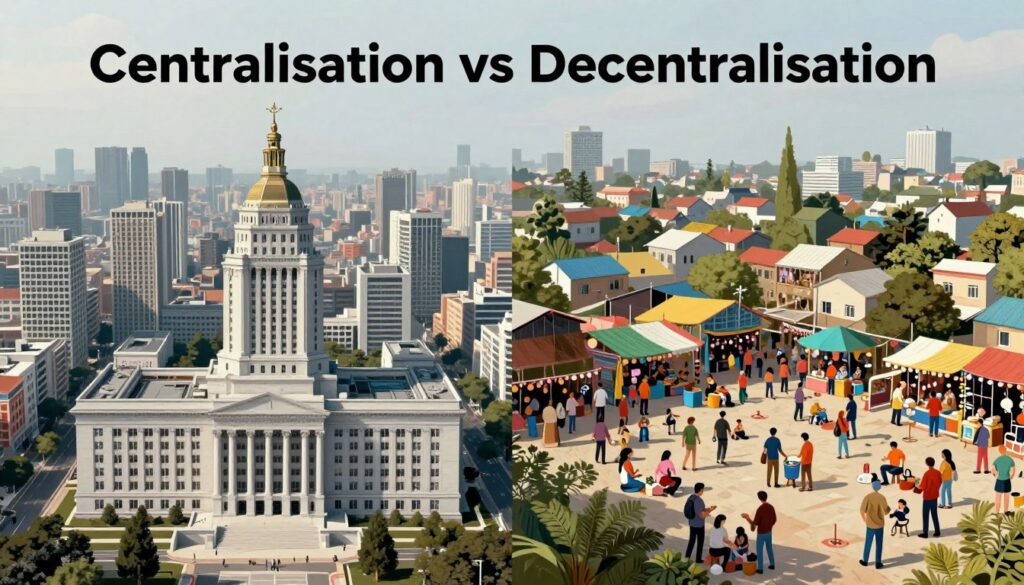
Centralisation vs Decentralisation: Understanding the Difference
The distinction between centralisation and decentralisation is fundamental to grasping how power and decision-making are distributed within a state or organization.
Key Differences Between the Two Systems
Centralisation and decentralisation are two contrasting governance structures that differ primarily in how they distribute power and authority.
Power Distribution Patterns
In a centralised system, power is concentrated in a single authority or central government, whereas in a decentralised system, power is dispersed among various levels of government or organizational units.
Centralisation typically involves a top-down approach where decisions are made by a central authority and then implemented across the organization or state.
Decision-Making Authority
Decentralisation, on the other hand, distributes the decision-making process among the constituents of the organization, allowing for more localized decision-making.
This distribution of authority enables decentralised systems to respond more effectively to local needs and conditions.
Resource Allocation Methods
The method of resource allocation also varies significantly between centralised and decentralised systems.
In centralised systems, resources are typically allocated based on decisions made by the central authority, whereas in decentralised systems, resource allocation is often more flexible and based on local priorities.
| Characteristics | Centralisation | Decentralisation |
|---|---|---|
| Power Distribution | Concentrated in a single authority | Dispersed among various levels |
| Decision-Making | Top-down approach | Localized decision-making |
| Resource Allocation | Centrally controlled | Flexible and locally prioritized |
When Each System Works Best
The choice between centralisation and decentralisation depends on various factors, including the size of the organization or state, the complexity of the issues being addressed, and the cultural context.
Centralisation can be effective in situations requiring swift, uniform decision-making, such as during national emergencies or in highly regulated industries.
On the other hand, decentralisation is often more suitable for large, diverse territories or organizations where local autonomy can lead to more effective governance and responsiveness to local needs.
Advantages of Centralized State Systems
The advantages of centralized state systems are multifaceted, impacting various aspects of governance and national development. Centralized governments can be more efficient in policy implementation and provide a stronger national unity and identity.
Efficiency in Policy Implementation
One of the primary benefits of a centralized state is its ability to implement policies efficiently across the entire territory. This is because decision-making authority is concentrated in a single location, allowing for quicker responses to national issues.
Key benefits of efficient policy implementation include:
- Rapid response to national emergencies
- Consistent application of laws and regulations
- Streamlined administrative processes
Uniformity and Consistency Across Regions
Centralized states ensure that laws, policies, and public services are uniform across all regions. This uniformity helps in promoting equality among citizens, regardless of their geographical location.
The benefits of uniformity include:
- Equal access to public services
- Consistent legal framework
- Simplified governance
Stronger National Unity and Identity
Centralized governance fosters a stronger sense of national unity and identity by promoting a shared culture, language, and set of values across the country.
Examples of how centralized states promote national unity include:
- National education curricula that emphasize shared history and values
- Standardized national symbols and celebrations
- Unified national policies on key issues
Streamlined Resource Mobilization
Centralized states can mobilize resources more effectively due to their control over national budgets and resource allocation. This enables them to respond to national priorities and emergencies more effectively.
| Benefits | Description |
|---|---|
| Efficient Budget Allocation | Centralized control allows for more strategic allocation of resources. |
| Rapid Response to Emergencies | Centralized governments can quickly mobilize resources to address emergencies. |
| National Development Projects | Large-scale development projects can be undertaken with ease due to centralized planning. |
Disadvantages of Centralized State Systems
While centralized governments have their advantages, they also come with significant disadvantages that impact local communities and governance. Centralized state systems can be bureaucratic and may lead to reduced local participation and representation.
Reduced Local Participation and Representation
One of the primary drawbacks of centralized systems is the limitation on local autonomy and participation in decision-making processes. When power is concentrated at the national level, local governments and communities may have limited ability to address their unique needs and concerns.
This can lead to a sense of disenfranchisement among local populations, as their voices are not adequately represented in the national government.
Potential for Authoritarian Rule
Centralized systems can also be prone to authoritarian tendencies, as the concentration of power can facilitate the suppression of dissent and opposition. Without checks and balances, centralized governments can become autocratic, undermining democratic principles and human rights.
Inefficiency in Addressing Local Issues
Furthermore, centralized governments often struggle to effectively address local issues due to their lack of understanding of local contexts. Policies made at the national level may not account for regional variations, leading to ineffective or even counterproductive solutions.
Bureaucratic Delays and Red Tape
Centralized systems are often criticized for their bureaucratic inefficiencies. The complex layers of administration can result in significant delays in decision-making and implementation, hindering the effective delivery of public services.
The following table highlights some key differences between centralized and decentralized systems in terms of local participation, policy implementation, and bureaucratic efficiency.
| Aspect | Centralized System | Decentralized System |
|---|---|---|
| Local Participation | Limited | High |
| Policy Implementation | Uniform, but potentially ineffective locally | Tailored to local needs |
| Bureaucratic Efficiency | Often slow due to red tape | Generally more efficient |

Centralised State Examples Around the World
Examples of centralized states are numerous and diverse, reflecting different historical, political, and cultural contexts. These countries showcase how the centralized state model can be implemented in various ways, each with its strengths and challenges.
France: A Classic Example of Centralization
France is often cited as a prime example of a centralized state, with a strong central government and limited regional autonomy. This structure is a legacy of its historical development, particularly during the Napoleonic era.
Government Structure and Power Distribution
The French government is characterized by a powerful central authority, with the President holding significant powers. The central government controls key sectors such as education, healthcare, and law enforcement.
How France Manages Regional Affairs
Despite its centralized nature, France has regions and departments that have some degree of autonomy. However, major decisions are still made at the national level, reflecting the country’s centralized governance structure.
China: Modern Centralized Governance
China represents a modern example of a centralized state, with the Communist Party exercising significant control over the government and society.
The Communist Party’s Central Authority
The Communist Party is the pivotal force in China’s governance, with its central committee making key decisions that affect the entire country.
Provincial Government Roles
While China has provincial governments, their autonomy is limited by the central government’s authority. Provinces are responsible for implementing national policies, with some flexibility to adapt to local conditions.
United Kingdom: Evolving Centralized System
The United Kingdom has a complex governance structure, with elements of centralization, particularly in its historical context.
Westminster’s Central Control
The UK Parliament in Westminster holds significant legislative power, and while there has been devolution to Scotland, Wales, and Northern Ireland, key areas remain under central control.
Devolution and Its Limits
Devolution has given regional governments some autonomy, but the extent of their powers is still defined by the central government, illustrating the ongoing balance between centralization and decentralization.
Nigeria’s Experience with Centralization
Nigeria, as a federal republic, has a governance structure that includes elements of centralization.
Federal Government Dominance
The federal government in Nigeria holds considerable power, particularly in areas such as defense and foreign policy. This central authority is crucial for national unity and stability.
State and Local Government Limitations
While Nigeria has 36 states and numerous local governments, their autonomy is constrained by the federal government’s control over key resources and policy areas.
Conclusion
A centralized state is characterized by a concentration of power in a single authority, uniform laws and policies, and a hierarchical administrative structure. Understanding the centralised state definition and characteristics of centralised state is crucial in appreciating the governance structure of various countries.
The discussion on centralized states has highlighted their historical development, key characteristics, and operational mechanisms. Examples from around the world, including France, China, and the United Kingdom, demonstrate the varying degrees of centralization and its implications.
As nations navigate the complexities of governance, recognizing the advantages and disadvantages of centralized systems is essential. While centralized states offer efficiency and uniformity, they also risk reduced local participation and potential authoritarian rule.
Ultimately, understanding centralized governance is vital for appreciating its impact on modern societies, particularly in countries like Nigeria, where governance structures continue to evolve.
