
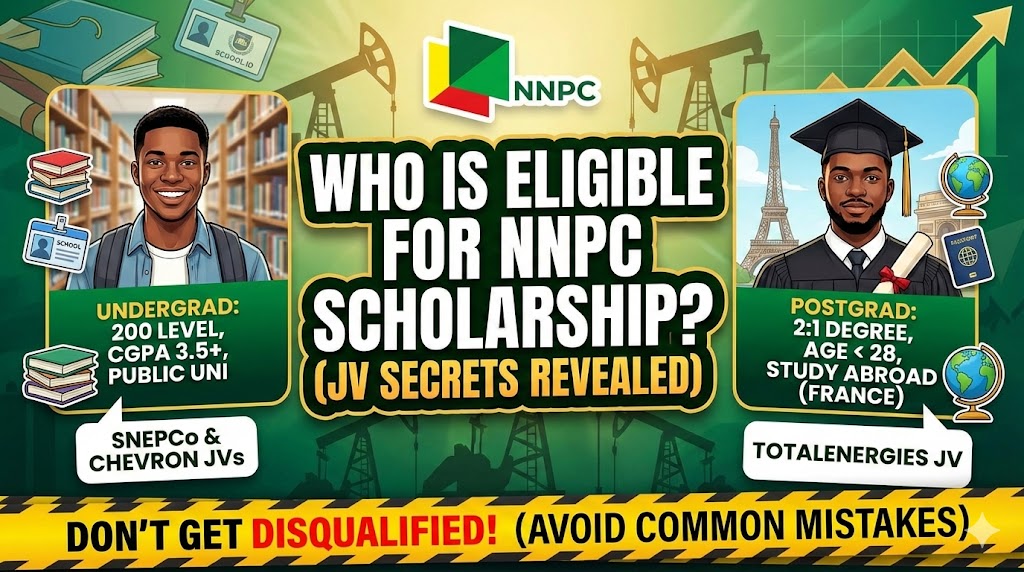
When students approach me and ask, “Who is eligible for the NNPC scholarship?“, the first thing I clarify is that there isn’t just one single program. Over my years of guiding students through financial aid applications, I have seen many miss out simply because they didn’t realize the Nigerian National Petroleum Company (NNPC) operates through several Joint Venture (JV) partnerships.
Whether you are looking at the SNEPCo, Chevron, Seplat, or TotalEnergies programs, each JV has its own specific targeting, though the baseline academic standards remain remarkably similar. My goal here is to break down these algorithmic requirements into simple, actionable steps so you know exactly where you stand before the application portals open.
Who is eligible for the NNPC scholarship at the undergraduate level?
To qualify for NNPC undergraduate scholarships, applicants must be Nigerian citizens enrolled full-time in their second year (200 level) at an NUC-accredited public university. You must maintain a minimum CGPA of 3.5 on a 5.0 scale and possess at least five O’Level credits, including English and Mathematics.
Most undergraduate schemes, such as the NNPC/SNEPCo and NNPC/Chevron scholarships, heavily prioritize students in STEM, Environmental Sciences, and Management disciplines. However, I always advise my students to look for the unique exceptions hidden in the guidelines. For instance, the NNPC/Chevron JV creates a highly inclusive pathway: visually impaired students are eligible with a significantly lower CGPA of 2.5.
It is also crucial to note that these programs are exclusively for public university students. If you attend a private institution, the application portals will automatically filter out your submission.
Who is eligible for the NNPC/TotalEnergies postgraduate scholarship?
The NNPC/TotalEnergies Master’s scholarship requires applicants to be Nigerian citizens aged 28 or younger. You must hold a bachelor’s degree with a minimum Second Class Upper (2:1) in Engineering, Geosciences, or Management Sciences, obtained within the last five years, and have completed your mandatory NYSC program.
Unlike the undergraduate grants, this postgraduate scheme is an international award that sponsors young scholars to study in France. You do not need an IELTS or TOEFL score to apply, provided your first degree was taught in English.
Here is a quick breakdown of the preferred undergraduate backgrounds for the postgraduate scheme:
| Study Area | Accepted Bachelor’s Degrees |
| Engineering | Petroleum, Mechanical, Civil, Electrical, Chemical |
| Geosciences | Geology, Geophysics, Geo-Informatics |
| Management Sciences | Business Administration, Accounting, Economics, Law |
What documents do I need for the NNPC scholarship application?
You must upload a recent passport photograph, your university or JAMB admission letter, original UTME and O’Level results, a valid school ID card, your 100-level academic transcript showing your CGPA, and a Local Government Area (LGA) letter of identification signed by authorized community officials.
Gathering your documents early is the secret to beating the short 14-day application windows. I recommend digitizing everything into clear JPEG formats (maximum 200KB per file) weeks before the portals open.
Here is my recommended step-by-step preparation process:
Verify your NIN: Ensure your National Identity Number matches your school records perfectly. You can verify your details through the National Identity Management Commission (NIMC).
Request your transcript early: Do not wait until the application opens to chase your Head of Department for your 100-level result slip.
Secure LGA identification: Get your letter stamped by your traditional ruler or Local Government Chairman.
Confirm accreditation: Verify that your specific course is currently approved by the National Universities Commission (NUC).
What factors will disqualify you from the NNPC scholarship?
You will be immediately disqualified if you are already a beneficiary of another oil and gas industry scholarship. Additionally, part-time students, students in private universities, 100-level or 300-level students, and applicants submitting falsified academic records or unverified community identification letters are strictly ineligible for this award.
This “no double-dipping” rule is strictly enforced across the industry. The scholarship boards share data, so if you are already receiving funds from Agbami or PTDF, attempting to secure an NNPC JV scholarship will result in permanent blacklisting. Always play by the rules and ensure every document you upload is authentic and legally verifiable.
