
What is the “La Cram La Pour” Meaning?
If you step onto almost any university campus in Nigeria, you will hear this phrase during exam season. The la cram la pour meaning is exactly what it sounds like.
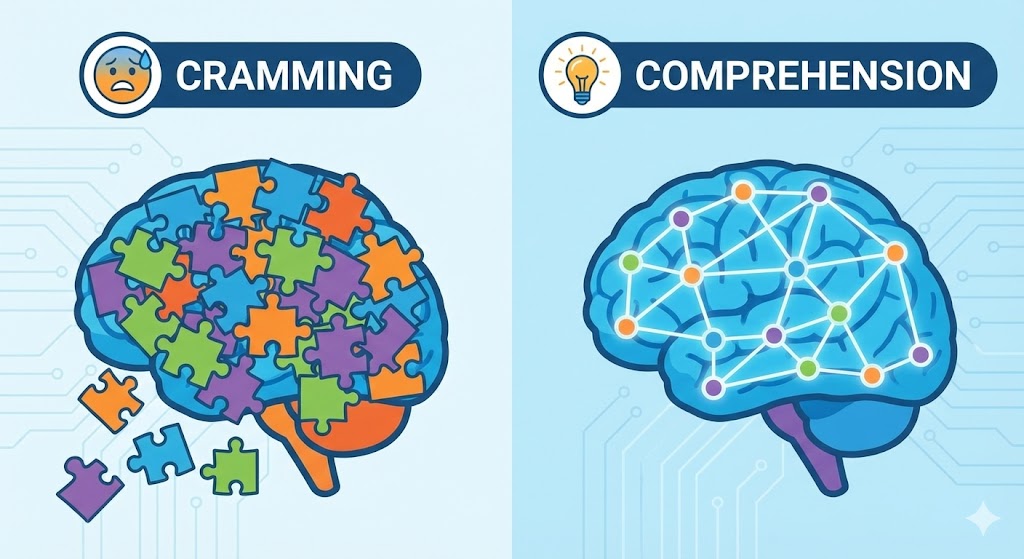
“La Cram” refers to the act of aggressive, rapid rote memorization. You are not trying to understand the material. You are simply forcing your brain to hold onto strings of words temporarily.
“La Pour” is the immediate aftermath. You sit in the exam hall and “pour” or vomit all that memorized information onto your answer booklet. It is a direct brain dump. Once the paper is submitted, the information vanishes from your memory completely.
Why Do Students Rely on This Method?
To fully grasp the la cram la pour meaning, you have to look at the pressure cooker that is the modern educational system. Students don’t cram because they want to. They do it to survive.
Is the Educational System to Blame?
Many outdated curriculums heavily reward reciting definitions over actually solving problems. If a lecturer marks you down for not using their exact wording, you adapt. You stop trying to understand the concept and just memorize the lecturer’s notes.
Do Bulky Handouts Cause Panic?
University semesters are notoriously short. Students are often expected to master massive volumes of information in just a few weeks. When faced with a 200-page handout three days before a test, deep comprehension feels impossible. Survival mode kicks in.
How Does Fear of Failure Drive Cramming?
There is immense psychological pressure from parents and society to secure high grades by any means necessary. According to research on student well-being by the American Psychological Association, academic pressure is a leading cause of extreme anxiety. When the fear of failure is that high, students will use whatever shortcut guarantees a passing grade.

What Are the Dangers of “Cramming and Pouring”?
When you internalize the la cram la pour meaning, you realize it is just a temporary band-aid. It hides much bigger problems.
How Does It Affect Long-Term Memory?
Information absorbed through cramming rarely makes it into your long-term memory. This is explained by a psychological concept known as the forgetting curve.
Within just 24 hours of cramming, your brain dumps the majority of that hastily memorized data. A study published by the National Library of Medicine confirms that sleep deprivation combined with cramming actually impairs memory retrieval. You end up working harder to remember less.
Does It Kill Critical Thinking?
Yes. Regurgitating notes prevents you from analyzing or applying knowledge. If an exam question is rephrased even slightly, a student who crammed will freeze. They only know the answer if the question matches their memorized cue perfectly.
Can It Hurt Your Future Career?
Absolutely. There is a massive gap between having a good certificate and possessing actual on-the-job skills. This is a primary driver of the current unemployability crisis. Employers don’t care if you can recite a textbook. They care if you can solve their problems.
Cramming vs. Comprehension: What is the Difference?
These two approaches are worlds apart. Cramming is surface-level rote learning. Comprehension is deep-level, meaningful learning.
When you cram, you are building a fragile house of cards. One trick question will blow it over.
When you comprehend, you are building a foundation of bricks. You understand the core mechanics of a topic. Because of this, you can adapt your knowledge to solve completely new, unseen problems.
How Can You Stop Cramming and Start Learning?
Escaping the la cram la pour meaning and its toxic cycle requires a totally new approach to studying. You need to study smarter.
What is the Feynman Technique?
This is a game-changer. The Feynman Technique involves explaining a complex concept in simple, everyday terms. Pretend you are teaching it to a 10-year-old. If you stumble or use confusing jargon, you have found a gap in your knowledge. Go back and review that specific part.
Why Should You Use Active Recall?
Stop passively re-reading your notes. It creates an illusion of competence. Instead, test yourself constantly. Close the book and try to write down everything you remember. This forces your brain to work hard to retrieve the information, which makes the memory stick.
How Can Spaced Repetition Help?
Spaced repetition is the exact opposite of cramming. You review your study materials at strategic, increasing intervals. You review it a day later, then three days later, then a week later. This systematically locks the data into your long-term memory.
Can Mind Maps Connect the Dots?
Visualizing your notes is incredibly powerful. Mind maps help you see how different topics relate to one another. It stops you from viewing course material as isolated facts and helps you understand the bigger picture.

What Can Schools Do to Change This Culture?
The burden is not just on the students. Educational institutions need a massive overhaul.
Should Exams Be More Practical?
Yes. We need to shift away from “define this term” to “solve this real-world problem.” When exams test application rather than memorization, cramming becomes useless.
Can Continuous Assessment Replace High-Stakes Exams?
Putting 70% of a student’s final grade on a single two-hour exam breeds anxiety. According to experts at Edutopia, frequent, low-stakes assessments reduce stress and promote consistent learning throughout the semester.
Why Do We Need Better Teacher Training?
Educators must be equipped to teach for understanding. Dictating notes for two hours straight is not teaching. Lecturers need training on interactive teaching methods that engage students and foster deep thinking.
Breaking the Cycle for Good
Now that you understand the la cram la pour meaning, you can consciously choose better study habits. Memorizing without understanding is a trap. It might get you through Friday’s exam, but it leaves you empty-handed when Monday’s real-world challenges hit.
Grades are obviously important. But ultimately, skills pay the bills. The next time you sit down to study, try to actually learn the material. Your future self will thank you.
Frequently Asked Questions (FAQs)
Is cramming ever a good idea?
Only in an absolute emergency. If you have completely ignored a subject and the exam is tomorrow, cramming might salvage a few points. But it should never be your primary study strategy.
How long does crammed information last in the brain?
Very rarely past a few days. The steep drop-off usually happens within the first 24 to 48 hours after the information is memorized.
What is the best alternative to rote learning?
Active recall paired with spaced repetition. Testing yourself on the material over an extended period of time is proven to be the most effective way to retain information permanently.
